© Ilja Mašík - Fotolia.com
Sitting in a window seat of an aeroplane during long distance flights can increase the risk of deep vein thrombosis (DVT), doctors say.
A window seat is one of the risk factors for DVT in long distance travellers outlined in new guidelines by the American College of Chest Physicians (ACCP), which say that a person's individual risk factors for blood clots should be taken into account before being offered preventative medicines.
Other risk factors highlighted include being elderly, pregnant or taking oral contraceptives.
The experts also say that so-called '"economy class syndrome" is a myth, as the risk of developing a blood clot during a long haul flight is the same for those travelling in first or business class.
Deep vein thromboses are blood clots which usually develop in the legs. If a clot breaks away, it can cause a potentially fatal blockage in the lungs known as a pulmonary embolism.
The new guidance, published in the journal Chest, says the risk of developing a blood clot on a long distance flight is "very small" for most people, but was increased for flights taking longer than eight or ten hours.
Prolonged sitting, such as in a window seat of a plane, can also increase the risk of DVT, but particularly in people with other risk factors.
Guidelines co-author Dr Mark Crowther from McMaster University, Ontario, said: "Travelling in economy class does not increase your risk for developing a blood clot, even during long-distance travel.
"However, remaining immobile for long periods of time will. Long distance travellers sitting in a window seat tend to have limited mobility, which increases their risk for DVT. This risk increases as other factors are present."
Smoking and obesity were also identified as risk factors, but the doctors said they found no "definitive evidence" that either dehydration or drinking alcohol boosted the risk of DVT.
Medical conditions which can put a person at increased risk include having had recent surgery, a family history of blood clots and having heart disease.
The guidelines recommend that all long-haul passengers should take preventative measures such as getting out of their seats and walking around, and calf muscle stretches.
In addition to this, people at higher risk of DVT should sit in an aisle seat if possible and wear below-knee graduated compression stockings, they advised.
The doctors also advised against the use of aspirin or any other anti-coagulant medication to prevent DVT in long-distance travellers.
Drugs which can prevent blood clotting should only be considered on an individual basis for those at a higher risk of DVT as the "adverse effects may outweigh the risks," they said.
Dr Gordon Guyatt, who chaired the panel of experts which drew up the guidelines, said: "There has been a significant push in health care to administer DVT prevention for every patient, regardless of risk.
"As a result, many patients are receiving unnecessary therapies that provide little benefit and could have adverse effects."
"The decision to administer DVT prevention therapy should be based on the patients' risk and the benefits of prevention or treatment."
Tuesday, February 07, 2012


Friday, February 03, 2012
White House Plans Nine-City Disability Tour
White House Plans Nine-City Disability Tour
By MICHELLE DIAMENT
February 2, 2012 Text Size A A
Obama administration officials are planning to fan out across the country starting this spring for a series of regional White House conferences to address disability issues.
In a conference call last week with leaders from several disability organizations, White House officials laid out preliminary plans for the events, according to those who participated in the call.
The regional meetings are expected to be held in Columbus, Ohio; Austin, Texas; Los Angeles; Denver; Atlanta; Boston; Minneapolis; Orlando, Fla.; and Kansas City, Mo. starting in mid-March, with some scheduled into the summer.
Exact details on who from the administration will be hosting the conferences and precisely what will be on the agenda were not revealed to advocates.
“I think it’s about showing what they’ve accomplished and letting folks at the regional level know where they can go for resources,” said Chris Thomson, vice president of corporate affairs and general counsel at United Cerebral Palsy, who was on the call. “It’s a little unclear, but I definitely think it’s an opportunity for people to express their concerns.”
A White House spokesman declined to comment on the plans.
By MICHELLE DIAMENT
February 2, 2012 Text Size A A
Obama administration officials are planning to fan out across the country starting this spring for a series of regional White House conferences to address disability issues.
In a conference call last week with leaders from several disability organizations, White House officials laid out preliminary plans for the events, according to those who participated in the call.
The regional meetings are expected to be held in Columbus, Ohio; Austin, Texas; Los Angeles; Denver; Atlanta; Boston; Minneapolis; Orlando, Fla.; and Kansas City, Mo. starting in mid-March, with some scheduled into the summer.
Exact details on who from the administration will be hosting the conferences and precisely what will be on the agenda were not revealed to advocates.
“I think it’s about showing what they’ve accomplished and letting folks at the regional level know where they can go for resources,” said Chris Thomson, vice president of corporate affairs and general counsel at United Cerebral Palsy, who was on the call. “It’s a little unclear, but I definitely think it’s an opportunity for people to express their concerns.”
A White House spokesman declined to comment on the plans.
Friday, January 20, 2012
Walk to Napel
Dear Madam / Sir,
My name is Andrea Lack and I am participating of the Nepal Trek called TREK FOR SOMEONE WHO CAN'T organised by the Muscular Dystrophy of Western Australia, the Research centre for neuromuscular diseases ....
As the name of our Trek says, me and my friends are trekking for the sake of children affected by Muscular Dystrophy ..or as in my case, Spinal Muscular Atrophy ,,,genetic disease which killed my 11 week old baby boy Alexander..Genetic disease which doesnt have cure ..... so Im trekking in the name of my son, to help the sick children in Nepal living in very bad conditions, so money we are raising are going to help to finish the project which will help disabled children in Nepal to live a more bearable life...this includes school, hospital and care centre
The Trek for someone who Can't will take place in Kathmandu from 17 th March to 1st April. All participants of the trek have a target to fundraise AUD 5000...just to help those children. I would very much appreciate if you could support me in any possible way.
For any further information, please, check the website...
I would like you to consider me in participation of this year’s rally as in any way you can. Donations can be paid to the address listed below....
Www.everydayhero.com.au/andrea_lack
Thank you for giving this your consideration
Yours Sincerely
My name is Andrea Lack and I am participating of the Nepal Trek called TREK FOR SOMEONE WHO CAN'T organised by the Muscular Dystrophy of Western Australia, the Research centre for neuromuscular diseases ....
As the name of our Trek says, me and my friends are trekking for the sake of children affected by Muscular Dystrophy ..or as in my case, Spinal Muscular Atrophy ,,,genetic disease which killed my 11 week old baby boy Alexander..Genetic disease which doesnt have cure ..... so Im trekking in the name of my son, to help the sick children in Nepal living in very bad conditions, so money we are raising are going to help to finish the project which will help disabled children in Nepal to live a more bearable life...this includes school, hospital and care centre
The Trek for someone who Can't will take place in Kathmandu from 17 th March to 1st April. All participants of the trek have a target to fundraise AUD 5000...just to help those children. I would very much appreciate if you could support me in any possible way.
For any further information, please, check the website...
I would like you to consider me in participation of this year’s rally as in any way you can. Donations can be paid to the address listed below....
Www.everydayhero.com.au/andrea_lack
Thank you for giving this your consideration
Yours Sincerely
Friday, January 06, 2012
This is the story of little Alex Laxa
Alex was born 10.8 2008 at 18.08 hours, a completely uneventful pregnancy. He was nearly born in the shopping mall, because upon our arrival to the hospital my contractions weren’t so strong, so I was recommended to walk it through, and come back when they are cime of birth loser apart...so my husband Steve took me to the nearby shopping centre to get some necessary shopping .waking around worked real well, with frequent stops when I had to bury my nail is the shopping trolley handle to keep up with contractions which become stronger...later I told him, that we really should come back to the hospital before it’s too late.. With his quick stop at Mc Donald’s to get some food, my water broke and we had to rush to the hospital which was luckily just 5 mins away I had really just time to climb on that birth bed, and in about 20 minutes, Alex was born... the nurse, when she marked the time of birth mentioned how many EIGHTS he has in the time of his arrival...it was 8th of October.2008..18.08...how lucky he will be in his life...When Alex was born, his cry was rather quiet, but I wasn’t worried, Madison, his sister wasn’t particularly loud baby herself I immediately checked his tiny face.. I passed the magical year of 35, when the genetically problems are more frequent, but I wasn’t recommended amniocentesis as my risk of Down syndrome wasn’t even increased. But looking into his beautiful, creased, frowning face my fear completely stopped.. Then we moved to the maternity ward, where Alex just slept and ate, if he cried, his voice was so quiet unlikely other babies and I was congratulating myself to such a contended baby..... Wrapped up constantly in the blanket so his head with cute bunch of black hair sticking out was visible...just a perfect baby boy....my happiness was complete, everybody around us was happy, grandparents proud of their first grandson.... Around his 4 weeks I noticed that his legs are barely moving, but he was my first baby boy, so I assumed that boys are a bit slower than girls. But I kept my eye on that. But after few more days I started to search internet, where I found the word HYPOTONIA, which indicated his problems, something like lower muscle mass...that was quite a shock to me, but then I thought, oh well, not everybody can be champion... his name AlEXANDER TERENCE LACK indicates something more...like a politician :)..I didn’t want to check which diseases are connected to hypotonic.....I didn’t want to know... I mentioned my worries to my husband who told me to calm down and relax, he is OK.... but it didn’t help me at all. I become obsessed with his legs, helped him to move them, to lift them... my sweet boy was looking at me smiling, not knowing what am I trying to do to him... My depression of not knowing what is wrong with him just hit the complete top. I needed to find out. So next day I took him to the local Health Nurse, which looking after babies in local area....when I got there in the waiting room was already a parents with their baby, which was pretty restless, crying kicking and wiggling.. Complete opposite of Alex, who was lying motionlessly in the pram, looking around...I found out the baby was even one week younger than Alex....and that was it..I knew, there is something really serious with him, which I get confirmed by the nurse who looked at him and told me, that she b=never ever saw anything like that... I run home and immediately rang my GP, for the earliest appointment. I managed to get one just the next day.. My GP, when I told her about Alex's lack of any ir very limited movements, was very confused. She even took some medical book of the shelf, look in there for a while, and then started Alex's reflexes. Which I realised HE HADNT ANY of them!! GP made some notes, than looked at me completely puzzled, told me I need to see some neurologist, she doesn’t have a clue what is wrong with him. And she recommended to get to the Princess Margaret Hospital for children, just to go to emergency. They will look at him... SO i did. The very next day, we drove there.. he was weighed and measured, and then e waited for some doctor in duty to have a look at him...when she came, I repeated again all his problems, she checked him...nodding she said she will call a neurologist.. After a while a young Indian neurologist came, and started Alex's reflexes again hitting him in his knee, when the leg should kick immediately. Nothing happened... I was sick worried....I knew he isn’t paralyzed, he just COULDNT move ! then the specialist recommends a hospitalization, so they can run a few tests on him. Funny enough I was very relieved... finally someone is going to find out, what is wrong with my baby. And then we can try to fix that.... They took us upstairs, Alex on a huge bed, I carried his car seat and our things,,,we were heading to the infant ward,. Where they put us in the room with another baby. In the meantime Steve arrived, ( I let him know that we are staying overnight and we need some stuff from home...), I told him quickly. What was happening when our nice Indian neurologist walked in accompanied with another 2 ladies doctors.. they let me undress Alex, straight away I saw something strange in their eyes when they saw Alex's bulging belly...( he had that pretty much always, as long as I remember, poor baby looked like a pregnant)...then they bend over above him and opened his mouth...I don’t know what they saw over there but clearly I could see i their expressions, when they looked at each other...and nodded.. Something was very very wrong... Then one of the ladies introduced herself as a Head neurologist and told us, that she is suspecting Spinal Muscular Atrophy... I remember how relieved I was; finally someone gave a name to his problem... O, I said. So what is the treatment? Lakshmi, the doctor looked at me for a short while, and then told me... sorry, but there is no cure for this....While
I was absorbing what she just said, my husband asked her how much time she thinks he has...and she replied...in his condition, about 6 months...what they were talking about? What 6 months??? He is perfect, he just can’t move his legs, so what are they talking about? Is he going to die??? Why? My brain just suddenly switched off, I couldn’t absorb any more information’s, I couldn’t do anything, I so wished to pass out, or to die.. I was pinching myself in my hand so hard, just to wake up from this ugly, horrible dream. This just couldn’t be real...it just simply couldn’t happening to me...but unfortunately...It WAS....why my brain didn’t do any mercy to me and let me live this through????? Then nurse came and quietly told us, that there is a private room just for us, and she will help us to move. I just walked behind her, not thinking, not feeling, just like a robot... in the room, where there was a hospital co and adult bed, together with a lovely bathroom...so spacey. With a nice view. But didn’t care, I was paralysed myself, my brain worked overtime, fighting depression, looking at our beautiful baby who was smiling at the nurse who changed his nappy, I just wasn’t able to do that, I wasn’t able to do anything....they asked if they should call a psychology, but I refused, I didn’t want to see anyone, talk to anyone, I just wanted to be left alone... They wanted us to keep overnight so they could run the SMA test in the morning which meant Alex couldn’t eat, he just was given some glucose, which he really didn’t like too much. He cried quite often...i looked at him, thinking how am I supposed to look after dying baby? Why me? That was so unfair!!! I remember even having thoughts of not wanting him anymore; put him in some hospice...because how am I supposed to look after dying baby??? This all thoughts speeded through my mind, my brain was overloaded, I even couldn’t cry, couldn’t think straight. I was in the shock.... Later on, when my husband left hospital home to be with poor daughter Madison, I was left alone with Alex in the hospital room, looking out of the window, watching traffic, and I envy all people sitting in those cars their minor, silly problems...thinking what i would do? What to tell all our friends? What it would be like when he will pass away? And WHEN? Will I be strong enough to watch him slowly dying, day by day??? I watched my son in his cot, unhappy with the feeding tube in his nose, he was so hungry, but I couldn’t feed him, as he was supposed to have his test done early in the morning.. The nurses left me alone with him, so I had to look after him by myself...giving him dummy in his tiny mouth; I stared at him, still feeling like in my worst nightmare... When nurse came with the breast pump, I wasn’t able to pump anything, I completely lost the milk. Luckily just only for that day I managed to fall asleep, just for an hour, when I woke up, Alex was next to me, in his cot with those tubes all around...no it wasn’t dream after all, just ugly reality....I felt sick.... Nurses kept coming, checking his temperature, checking all those machines, whispering to him, how cute he is, special boy.... In the morning Alex was taken for is tests, head nurse came to tell me the social worker will come to see us, also the head of the ward came to ask if we are ok, if there is anything, they will do whatever possible, and gave me a big hug...they were just all too nice My husband came in the midmorning, forced me to eat something. Food was the last thing in my mind; my jaws were just locked together. Then all the people started to come... the social worker was the biggest help. I told him all my feelings, my though. He said all that is normal, from now on I should just live day by day, not to plan anything, just enjoy every day...forget the future..... Which I did eventually Nurse took Alex's blood and they wanted us to stay another night at the hospital, to provide a nerve biopsy, which would give us the 100% results..... Next night in the hospital was as bad as the first one, Alex was taken to the biopsy, and Steve took me out of the hospital, for lunch and shopping...out there I felt like an alien. Walking amongst all those people who were enjoying lovely spring day, having fun, chatting to each other....nobody knew how huge sorrow I had in my heart, nobody could feel what I did... I felt so alone.... I so wanted to be in anyone else skin. Just to switch my brain completely off...possibly forever... We get back to the hospital, Alex was brought back a while after us....his eyes red and wet, he probably cried a lot, at that test..my poor baby... Lakshmi, the neurologist told us, that the tests confirmed SMA 1, but the 100% assurance will come from the blood tests...and we were offered another night at the hospital. Which I refused, I had enough of that place, full of "just normally sick" babies, which would eventually get better, will get home, ..will continue their life.... at that moment, that was too hard ... Weird feeling to take your baby away from the hospital, baby which seems perfect, but was already given the death sentence... weird listening to the peoples compliments about how beautiful your baby is. We left for home in absolute silence. But when we reached home I felt much better. I felt stronger, I wanted to give my dying baby the best time of any baby life, and he would be showered with love, people, and actions. He will not be left alone for just a single minute...as we didn’t have a clue how much time we have.... together.... ENDING 30th December 2008 .that night was very bad, Alex didn’t sleep at all, kept me awake all night...day before we decided to go to some animal pace to keep my daughter happy, Alex had a big problems with feeding..(.which started already beginning of December...but now, it was quite critical, I fed him a half a bottle for about 2-3 hours! Last bottle he finished was exactly on Christmas day, that seemed like he wanted to make me really happy, which he did...that was my best present...and since then.. He just didn’t eat. His feeding and drinking was the only thing I could think about. Especially drinking...the day temperatures reached 35C, so drink was really important... Day before I wanted to keep him cool, so I decided to bath him outside. Then my sister in law came over, seeing him, she busted in tears...she apologized for that, but then I realised, how horrible he looked... he was so pale, his breathing really rapid, his chest lifting up and down, so so skinny... looking at him, I decided if he is not better the next day, I will take him to the hospital...I realised now it would be the time for the feeding tube. Or tube straight into his tummy. To get better... evidently his sucking muscle were giving up ... So the next morning after the horrible night I announced my mum and my dad, who were just visiting from Europe, that we are going to the hospital. My mother in law went with me, keeping me company...and we were heading to the Emergency department of Princess Margaret Hospital.... At the waiting room we expected a long delay as usual, but we were taken straight away. I had to tale clothes off Alex to weigh him, while waiting for the doctor...Then I found out that my baby weights just a 200g in his nearly 3 months.....more than he was born!!! He lost so much weight I just didn’t realised!! Doctor who came asked about his problems, and about any know condition, I told him he is SMA baby. He didn’t seem bothered, just asked if his breathing is normally as fast as that...I said yes, he has SMA... and then of his belly is always as big...I got really angry, I told him yes, he is textbook SMA baby.. the doctor simply didn’t have a clue, what SMA IS !!! They found out that Alex's breathing is really bad and he was given an oxygen mask. Suddenly there was a crowd of doctors and nurses All running around. And I felt so relieved; finally someone is taking proper care about my baby..... Suddenly Lakshmi, our neurologist came, she was just informed about our arrival, so she rushed to see us... looked quickly at Alex and told me to follow her...that we need to talk. ..in one of the close by rooms we sat down, she had very serious expression in her eyes. Telling me that Alex's time may have come, or is quite close. And we need to discuss what is your decision...if he is about to pass away. Will you want to keep him alive at any cost with the help of breathing machines or just let him slip away, as we agreed to that before.. (We discussed this question before, and me and my husband agreeed that we dont want to prolong our sons misery, breathing machine wasnt an answer ..it would just prolong his..and our helplessness)..and was still positive about that...I couldnt watch my son suffer anymore, just watching him lying at the bed, so tiny, so sick..was tearing my heart apart....) she had to ask, even when she knew our decision form before, but now...the situation got more real....so I said no..I dont want him to suffer...he had enough.... She kept some otimism though, she said so far it will definitely looks like a feeding tube AND a breathing machine, which MIGHT be temporary..if he starts breathing on his own again...but we we will definitely leave the hospital with the oxygen tanks...and he has to stay hospitalized as he is very dehydrated, which I agreeded immediately.. They took us to the infant ward again, we got another private room, not the previous one, but right the next one.. they parked Alex next to the big bed and left,,and we stayed alone just with our sweet little boy, who was finally sleeping, probably being sedated....They put his head into some clear plastic box with oxygen, instead the breathing mask, which he hated so much..he was allowed to be taken off the box, but he needed to have the oxygen musk right in front of his face, lying on he pillow..all the time, with us...later on my mum in law left for home, talked to my mum who was persistent to be with us, so we arranged her to come the very next morning...so the last day of the year, instead of heavy celebration we will spend oin hospital...The nurses were coming all the time, checking if we are ok, especially two of them Beth and Amanda were just amazing...I knew straight away, whatever happened they will never forget us... We had one of the last nights with Alex ahead of us.... 31st December The night at the hospital was horrible, ALex was very uncomfortable, kept crying, which hurt me so much...to be unable to help is the worst feeling... In the morning my husband came, together with my parents and Madison, m mum and dad were stunned when the saw Alex, their eyes teary straight away, mum hugged me... While they were around, I and my Husband were taken to the Respiratory department to be shown how the breathing machines works. Our neurologist organised that for us. We were shown a HUGE heavy oxygen tanks which we were supposed to take home, Alex would use them constantly while at home, one of them should last 2-3 days, we were supposed to take 3 of them...and if we want him to take him for a walk, there were a smaller ones, which could fit the basket under the pram, just about...each of them lasted a few hours..5 of those The doctor showed us everything, how to use that, how to operate, and we were staring in disbelief...this is what we DIDNT want for our son, we wanted as much quality life as possible,, anyway, the transport of all these tanks were already organised on our discharge...free delivery, free usage...brilliant. When we get back to our room, Alex was up and unhappy, not crying but moaning. I couldn’t bear that anymore, I asked the nurse to give him something so he doesn’t suffer, so he doesn’t feel the pain....he finally fall asleep on the pillow, being cuddled by my mum, with the mask in front of his tiny face...... Then Stephanie, lady from Palliative care came. And that was the break thru... she looked at Alex and told me straight away, that he looks really bad, an she thinks that he will not be able to make it.. i looked at my baby.... he changed so much, he didn’t look like himself anymore... I knew, she was right. THE time was coming...very fast....and suddenly I realised that my daughter didn’t know what is happening...we didn’t have chance to tell her...so Stephanie did. She explained that Alex is very sick baby. So sick that he cannot live anymore...it was so emotional, poor Madison was so confused, hugged me and told me she doesn’t want her brother to die, that she loves him...OMG, that was so so hard, so unbearable....luckily my husband took her away. To some toy shop and the they left.. My sister in law came with her husband. To say good bye to Alex as we told everybody that we will not bring Alex home with us anymore.. They stayed all night with us, we "celebrated" incoming New Year..... Day of Madisons 6th Birthday...and then everybody left ...together with Alex's car seat, which was obvious we will not use anymore, my baby will never sit in it anymore....just me and my mum stayed that night ,,the very last night with Alex
THE END...
I was absorbing what she just said, my husband asked her how much time she thinks he has...and she replied...in his condition, about 6 months...what they were talking about? What 6 months??? He is perfect, he just can’t move his legs, so what are they talking about? Is he going to die??? Why? My brain just suddenly switched off, I couldn’t absorb any more information’s, I couldn’t do anything, I so wished to pass out, or to die.. I was pinching myself in my hand so hard, just to wake up from this ugly, horrible dream. This just couldn’t be real...it just simply couldn’t happening to me...but unfortunately...It WAS....why my brain didn’t do any mercy to me and let me live this through????? Then nurse came and quietly told us, that there is a private room just for us, and she will help us to move. I just walked behind her, not thinking, not feeling, just like a robot... in the room, where there was a hospital co and adult bed, together with a lovely bathroom...so spacey. With a nice view. But didn’t care, I was paralysed myself, my brain worked overtime, fighting depression, looking at our beautiful baby who was smiling at the nurse who changed his nappy, I just wasn’t able to do that, I wasn’t able to do anything....they asked if they should call a psychology, but I refused, I didn’t want to see anyone, talk to anyone, I just wanted to be left alone... They wanted us to keep overnight so they could run the SMA test in the morning which meant Alex couldn’t eat, he just was given some glucose, which he really didn’t like too much. He cried quite often...i looked at him, thinking how am I supposed to look after dying baby? Why me? That was so unfair!!! I remember even having thoughts of not wanting him anymore; put him in some hospice...because how am I supposed to look after dying baby??? This all thoughts speeded through my mind, my brain was overloaded, I even couldn’t cry, couldn’t think straight. I was in the shock.... Later on, when my husband left hospital home to be with poor daughter Madison, I was left alone with Alex in the hospital room, looking out of the window, watching traffic, and I envy all people sitting in those cars their minor, silly problems...thinking what i would do? What to tell all our friends? What it would be like when he will pass away? And WHEN? Will I be strong enough to watch him slowly dying, day by day??? I watched my son in his cot, unhappy with the feeding tube in his nose, he was so hungry, but I couldn’t feed him, as he was supposed to have his test done early in the morning.. The nurses left me alone with him, so I had to look after him by myself...giving him dummy in his tiny mouth; I stared at him, still feeling like in my worst nightmare... When nurse came with the breast pump, I wasn’t able to pump anything, I completely lost the milk. Luckily just only for that day I managed to fall asleep, just for an hour, when I woke up, Alex was next to me, in his cot with those tubes all around...no it wasn’t dream after all, just ugly reality....I felt sick.... Nurses kept coming, checking his temperature, checking all those machines, whispering to him, how cute he is, special boy.... In the morning Alex was taken for is tests, head nurse came to tell me the social worker will come to see us, also the head of the ward came to ask if we are ok, if there is anything, they will do whatever possible, and gave me a big hug...they were just all too nice My husband came in the midmorning, forced me to eat something. Food was the last thing in my mind; my jaws were just locked together. Then all the people started to come... the social worker was the biggest help. I told him all my feelings, my though. He said all that is normal, from now on I should just live day by day, not to plan anything, just enjoy every day...forget the future..... Which I did eventually Nurse took Alex's blood and they wanted us to stay another night at the hospital, to provide a nerve biopsy, which would give us the 100% results..... Next night in the hospital was as bad as the first one, Alex was taken to the biopsy, and Steve took me out of the hospital, for lunch and shopping...out there I felt like an alien. Walking amongst all those people who were enjoying lovely spring day, having fun, chatting to each other....nobody knew how huge sorrow I had in my heart, nobody could feel what I did... I felt so alone.... I so wanted to be in anyone else skin. Just to switch my brain completely off...possibly forever... We get back to the hospital, Alex was brought back a while after us....his eyes red and wet, he probably cried a lot, at that test..my poor baby... Lakshmi, the neurologist told us, that the tests confirmed SMA 1, but the 100% assurance will come from the blood tests...and we were offered another night at the hospital. Which I refused, I had enough of that place, full of "just normally sick" babies, which would eventually get better, will get home, ..will continue their life.... at that moment, that was too hard ... Weird feeling to take your baby away from the hospital, baby which seems perfect, but was already given the death sentence... weird listening to the peoples compliments about how beautiful your baby is. We left for home in absolute silence. But when we reached home I felt much better. I felt stronger, I wanted to give my dying baby the best time of any baby life, and he would be showered with love, people, and actions. He will not be left alone for just a single minute...as we didn’t have a clue how much time we have.... together.... ENDING 30th December 2008 .that night was very bad, Alex didn’t sleep at all, kept me awake all night...day before we decided to go to some animal pace to keep my daughter happy, Alex had a big problems with feeding..(.which started already beginning of December...but now, it was quite critical, I fed him a half a bottle for about 2-3 hours! Last bottle he finished was exactly on Christmas day, that seemed like he wanted to make me really happy, which he did...that was my best present...and since then.. He just didn’t eat. His feeding and drinking was the only thing I could think about. Especially drinking...the day temperatures reached 35C, so drink was really important... Day before I wanted to keep him cool, so I decided to bath him outside. Then my sister in law came over, seeing him, she busted in tears...she apologized for that, but then I realised, how horrible he looked... he was so pale, his breathing really rapid, his chest lifting up and down, so so skinny... looking at him, I decided if he is not better the next day, I will take him to the hospital...I realised now it would be the time for the feeding tube. Or tube straight into his tummy. To get better... evidently his sucking muscle were giving up ... So the next morning after the horrible night I announced my mum and my dad, who were just visiting from Europe, that we are going to the hospital. My mother in law went with me, keeping me company...and we were heading to the Emergency department of Princess Margaret Hospital.... At the waiting room we expected a long delay as usual, but we were taken straight away. I had to tale clothes off Alex to weigh him, while waiting for the doctor...Then I found out that my baby weights just a 200g in his nearly 3 months.....more than he was born!!! He lost so much weight I just didn’t realised!! Doctor who came asked about his problems, and about any know condition, I told him he is SMA baby. He didn’t seem bothered, just asked if his breathing is normally as fast as that...I said yes, he has SMA... and then of his belly is always as big...I got really angry, I told him yes, he is textbook SMA baby.. the doctor simply didn’t have a clue, what SMA IS !!! They found out that Alex's breathing is really bad and he was given an oxygen mask. Suddenly there was a crowd of doctors and nurses All running around. And I felt so relieved; finally someone is taking proper care about my baby..... Suddenly Lakshmi, our neurologist came, she was just informed about our arrival, so she rushed to see us... looked quickly at Alex and told me to follow her...that we need to talk. ..in one of the close by rooms we sat down, she had very serious expression in her eyes. Telling me that Alex's time may have come, or is quite close. And we need to discuss what is your decision...if he is about to pass away. Will you want to keep him alive at any cost with the help of breathing machines or just let him slip away, as we agreed to that before.. (We discussed this question before, and me and my husband agreeed that we dont want to prolong our sons misery, breathing machine wasnt an answer ..it would just prolong his..and our helplessness)..and was still positive about that...I couldnt watch my son suffer anymore, just watching him lying at the bed, so tiny, so sick..was tearing my heart apart....) she had to ask, even when she knew our decision form before, but now...the situation got more real....so I said no..I dont want him to suffer...he had enough.... She kept some otimism though, she said so far it will definitely looks like a feeding tube AND a breathing machine, which MIGHT be temporary..if he starts breathing on his own again...but we we will definitely leave the hospital with the oxygen tanks...and he has to stay hospitalized as he is very dehydrated, which I agreeded immediately.. They took us to the infant ward again, we got another private room, not the previous one, but right the next one.. they parked Alex next to the big bed and left,,and we stayed alone just with our sweet little boy, who was finally sleeping, probably being sedated....They put his head into some clear plastic box with oxygen, instead the breathing mask, which he hated so much..he was allowed to be taken off the box, but he needed to have the oxygen musk right in front of his face, lying on he pillow..all the time, with us...later on my mum in law left for home, talked to my mum who was persistent to be with us, so we arranged her to come the very next morning...so the last day of the year, instead of heavy celebration we will spend oin hospital...The nurses were coming all the time, checking if we are ok, especially two of them Beth and Amanda were just amazing...I knew straight away, whatever happened they will never forget us... We had one of the last nights with Alex ahead of us.... 31st December The night at the hospital was horrible, ALex was very uncomfortable, kept crying, which hurt me so much...to be unable to help is the worst feeling... In the morning my husband came, together with my parents and Madison, m mum and dad were stunned when the saw Alex, their eyes teary straight away, mum hugged me... While they were around, I and my Husband were taken to the Respiratory department to be shown how the breathing machines works. Our neurologist organised that for us. We were shown a HUGE heavy oxygen tanks which we were supposed to take home, Alex would use them constantly while at home, one of them should last 2-3 days, we were supposed to take 3 of them...and if we want him to take him for a walk, there were a smaller ones, which could fit the basket under the pram, just about...each of them lasted a few hours..5 of those The doctor showed us everything, how to use that, how to operate, and we were staring in disbelief...this is what we DIDNT want for our son, we wanted as much quality life as possible,, anyway, the transport of all these tanks were already organised on our discharge...free delivery, free usage...brilliant. When we get back to our room, Alex was up and unhappy, not crying but moaning. I couldn’t bear that anymore, I asked the nurse to give him something so he doesn’t suffer, so he doesn’t feel the pain....he finally fall asleep on the pillow, being cuddled by my mum, with the mask in front of his tiny face...... Then Stephanie, lady from Palliative care came. And that was the break thru... she looked at Alex and told me straight away, that he looks really bad, an she thinks that he will not be able to make it.. i looked at my baby.... he changed so much, he didn’t look like himself anymore... I knew, she was right. THE time was coming...very fast....and suddenly I realised that my daughter didn’t know what is happening...we didn’t have chance to tell her...so Stephanie did. She explained that Alex is very sick baby. So sick that he cannot live anymore...it was so emotional, poor Madison was so confused, hugged me and told me she doesn’t want her brother to die, that she loves him...OMG, that was so so hard, so unbearable....luckily my husband took her away. To some toy shop and the they left.. My sister in law came with her husband. To say good bye to Alex as we told everybody that we will not bring Alex home with us anymore.. They stayed all night with us, we "celebrated" incoming New Year..... Day of Madisons 6th Birthday...and then everybody left ...together with Alex's car seat, which was obvious we will not use anymore, my baby will never sit in it anymore....just me and my mum stayed that night ,,the very last night with Alex
THE END...
Wednesday, December 21, 2011
: Can you drive safely and talk on a hands-free mobile phone?
Q: Can you drive safely and talk on a hands-free mobile phone?
A: No, using your mobile in any way while driving increases your risk of an accident.
Our expert: Professor Mark Stevenson
Published 21/07/2010
Have your say
Do you use your mobile phone while driving? If so, why? Have your say on the messageboard below.
Conditions of Use
Most of us love our mobile phones. They make our lives so much easier – letting us send text messages, play music, download maps, surf the internet, and have a conversation – anywhere, anytime.
But one of the few places you should avoid using your mobile is the car, especially if you are the driver. Research clearly shows that driving while using your mobile increases your risk of an accident. However, is that still the case if your mobile is in hands-free mode?
While they free your hands for the steering wheel, hands-free phones don't make driving any safer, says Professor Mark Stevenson, senior director at The George Institute at the University of Sydney.
Whether you are using a hands-free mobile or a regular mobile phone your risk of an accident is "around four times higher compared to a driver who doesn't use a phone," Stevenson says.
Dangerous combination
Prof Stevenson has been studying the relationship between mobile phones and traffic accidents since 2005. He has been comparing individuals who've gone to hospital after traffic accidents, with their mobile phone billing records – to see if there's any correlation between car accidents and phone use.
Stevenson says their findings are similar to those of other researchers worldwide. That is: using any kind of mobile phone, including a hands-free mobile phone, significantly increases your risk of an accident.
Phone manufacturers developed hands-free mobiles in the mid-1990s, in an effort to reduce the number of phone-related accidents. Most of these phone units (either portable or built into the car) are activated by the driver's voice so the driver speaks and hears the caller's voice through the speaker. This helps to free-up your hands for the steering wheel.
Not about your hands
But it's not what your hands are doing (or not doing) that increases your chances of having an accident, Stevenson says – it's the effect of your phone call on your concentration.
When you answer your mobile phone while you are behind the wheel you disengage from the task of driving. Talking on a mobile phone also makes you less focused on the road itself and traffic conditions. It's this lack of attention to driving conditions that slows down your reaction time, thereby increasing your chances of having an accident.
And while having passengers in the car – and talking to them while driving – has also been found to increase the risk of accident, research has found this risk is less than that posed by mobile phone conversations. One possible reason is that passengers are more aware of the road conditions you're experiencing and so are more inclined to moderate their conversation.
People whose work requires that they drive a lot and use the phone – such as travelling salespeople – are especially at risk of phone-related accidents as they are more likely to engage in long and involved business conversations whilst driving.
Disconnect between science and the law
Unfortunately, current legislation in Australia (as in most other Western countries) doesn't seem to reflect the growing body of evidence that hands-free phones are just as dangerous as any other phone in the car, says Stevenson.
In all Australian states, using hand-held mobile phones while driving is illegal – while hands-free mobiles are perfectly legal. (The exception is P-plate drivers who are not allowed to use any type of phone, hand-held or hands-free.)
Also mobile phone manufacturers are able to market hands-free systems as safe alternatives to hand-held phones – despite the research evidence to the contrary.
The New South Wales Roads and Traffic Authority recommends you make your calls before or after your trip. If you need to make or take a call while driving, pull over safely by the side of the road. And if you must use a hands-free phone while driving then you should:
make sure the device is set up and working before you start the car.
keep your conversation short.
never take notes, look up phone numbers, or read or send text messages while driving.
avoid complex or emotional phone conversations whilst driving.
don't make calls in heavy traffic or poor weather conditions.
end the call if it is distracting you from driving.
As of July 23 2010 Professor Mark Stevenson will be based at the Accident Research Centre at Monash University.
A: No, using your mobile in any way while driving increases your risk of an accident.
Our expert: Professor Mark Stevenson
Published 21/07/2010
Have your say
Do you use your mobile phone while driving? If so, why? Have your say on the messageboard below.
Conditions of Use
Most of us love our mobile phones. They make our lives so much easier – letting us send text messages, play music, download maps, surf the internet, and have a conversation – anywhere, anytime.
But one of the few places you should avoid using your mobile is the car, especially if you are the driver. Research clearly shows that driving while using your mobile increases your risk of an accident. However, is that still the case if your mobile is in hands-free mode?
While they free your hands for the steering wheel, hands-free phones don't make driving any safer, says Professor Mark Stevenson, senior director at The George Institute at the University of Sydney.
Whether you are using a hands-free mobile or a regular mobile phone your risk of an accident is "around four times higher compared to a driver who doesn't use a phone," Stevenson says.
Dangerous combination
Prof Stevenson has been studying the relationship between mobile phones and traffic accidents since 2005. He has been comparing individuals who've gone to hospital after traffic accidents, with their mobile phone billing records – to see if there's any correlation between car accidents and phone use.
Stevenson says their findings are similar to those of other researchers worldwide. That is: using any kind of mobile phone, including a hands-free mobile phone, significantly increases your risk of an accident.
Phone manufacturers developed hands-free mobiles in the mid-1990s, in an effort to reduce the number of phone-related accidents. Most of these phone units (either portable or built into the car) are activated by the driver's voice so the driver speaks and hears the caller's voice through the speaker. This helps to free-up your hands for the steering wheel.
Not about your hands
But it's not what your hands are doing (or not doing) that increases your chances of having an accident, Stevenson says – it's the effect of your phone call on your concentration.
When you answer your mobile phone while you are behind the wheel you disengage from the task of driving. Talking on a mobile phone also makes you less focused on the road itself and traffic conditions. It's this lack of attention to driving conditions that slows down your reaction time, thereby increasing your chances of having an accident.
And while having passengers in the car – and talking to them while driving – has also been found to increase the risk of accident, research has found this risk is less than that posed by mobile phone conversations. One possible reason is that passengers are more aware of the road conditions you're experiencing and so are more inclined to moderate their conversation.
People whose work requires that they drive a lot and use the phone – such as travelling salespeople – are especially at risk of phone-related accidents as they are more likely to engage in long and involved business conversations whilst driving.
Disconnect between science and the law
Unfortunately, current legislation in Australia (as in most other Western countries) doesn't seem to reflect the growing body of evidence that hands-free phones are just as dangerous as any other phone in the car, says Stevenson.
In all Australian states, using hand-held mobile phones while driving is illegal – while hands-free mobiles are perfectly legal. (The exception is P-plate drivers who are not allowed to use any type of phone, hand-held or hands-free.)
Also mobile phone manufacturers are able to market hands-free systems as safe alternatives to hand-held phones – despite the research evidence to the contrary.
The New South Wales Roads and Traffic Authority recommends you make your calls before or after your trip. If you need to make or take a call while driving, pull over safely by the side of the road. And if you must use a hands-free phone while driving then you should:
make sure the device is set up and working before you start the car.
keep your conversation short.
never take notes, look up phone numbers, or read or send text messages while driving.
avoid complex or emotional phone conversations whilst driving.
don't make calls in heavy traffic or poor weather conditions.
end the call if it is distracting you from driving.
As of July 23 2010 Professor Mark Stevenson will be based at the Accident Research Centre at Monash University.
Bureaucracy' leaves disabled man in hospital
'Bureaucracy' leaves disabled man in hospital
By Anna Morozow
Updated December 21, 2011 14:59:08
PHOTO: A Legislative Assembly committee has been told a disabled man has been in hospital for more than year because he cannot get the public housing he needs. (Giulio Saggin, file photo: ABC News)
MAP: Canberra 2600
An ACT Legislative Assembly committee has been told a lack of cooperation between different government services has left a disabled man stuck in hospital for more than a year with nowhere else to live.
The Committee on Health, Community and Social Services is investigating the provision of social housing in the ACT, and has been told people with disabilities often have to wait a lot longer for housing because there is not enough suitable accommodation.
Fiona May from the ACT Disability, Aged and Carer Advocacy Service says one of her group's clients has been in hospital for about two years waiting for suitable housing.
"Because [ACT] Housing maintains that a house cannot be allocated until support services are in place and Disability ACT maintains that they cannot set up support services until a house is provided," she said.
Ms May says bureaucracy has prevented government agencies from working cohesively to find a solution.
She says the man has been in hospital so long he has become institutionalised and now does not want to leave.
"This client has very complex needs and does need a very high level of care, which he is getting in hospital," she said.
"Unfortunately neither Housing nor Disability are prepared to work together sufficiently in order to enable that to happen in a non-hospital setting at this time."
Ms May says the Government needs to collect data on how many of its public housing clients have disabilities or special needs, so it can provide more suitable accommodation.
She says ACT Housing does not keep comprehensive data on its clients' needs.
"Those are the sorts of things I think would inform Housing's planning," she said.
"If they know how many people are looking for social housing who have a disability that would inform how many houses they need to build that actually have the right sort of accessibility."
A spokesman for Community Services Minister Joy Burch says all agencies are working together to find a solution for the man, but his needs are very complex.
By Anna Morozow
Updated December 21, 2011 14:59:08
PHOTO: A Legislative Assembly committee has been told a disabled man has been in hospital for more than year because he cannot get the public housing he needs. (Giulio Saggin, file photo: ABC News)
MAP: Canberra 2600
An ACT Legislative Assembly committee has been told a lack of cooperation between different government services has left a disabled man stuck in hospital for more than a year with nowhere else to live.
The Committee on Health, Community and Social Services is investigating the provision of social housing in the ACT, and has been told people with disabilities often have to wait a lot longer for housing because there is not enough suitable accommodation.
Fiona May from the ACT Disability, Aged and Carer Advocacy Service says one of her group's clients has been in hospital for about two years waiting for suitable housing.
"Because [ACT] Housing maintains that a house cannot be allocated until support services are in place and Disability ACT maintains that they cannot set up support services until a house is provided," she said.
Ms May says bureaucracy has prevented government agencies from working cohesively to find a solution.
She says the man has been in hospital so long he has become institutionalised and now does not want to leave.
"This client has very complex needs and does need a very high level of care, which he is getting in hospital," she said.
"Unfortunately neither Housing nor Disability are prepared to work together sufficiently in order to enable that to happen in a non-hospital setting at this time."
Ms May says the Government needs to collect data on how many of its public housing clients have disabilities or special needs, so it can provide more suitable accommodation.
She says ACT Housing does not keep comprehensive data on its clients' needs.
"Those are the sorts of things I think would inform Housing's planning," she said.
"If they know how many people are looking for social housing who have a disability that would inform how many houses they need to build that actually have the right sort of accessibility."
A spokesman for Community Services Minister Joy Burch says all agencies are working together to find a solution for the man, but his needs are very complex.
Saturday, December 17, 2011
Dear Tom,
Dear Tom,
You may recall we recently met outside the Point in Dublin, when I offered to take a picture of you and your friend.
I am currently doing an Executive MBA at UCD Michael Smurfit Business School and as part of our course, my fellow student David Rehill and I are currently undertaking an Organisational Behaviour & Decision Making Assignment, which is focusing on Aer Lingus' Communication with Disabled and Elderly Passengers. In terms of our individual background, David is a Chartered Civil Engineer and an Associate at O'Connor Sutton Cronin & I am a Chartered Town Planner, have my own business and am an External Member of the NAMA Board. We both have done work in relation to disability issues and indeed my own brother has Cerebral Palsy.
We have developed a Passenger Communications Process diagram, a copy of which is attached, to illustrate the communications process that the average disabled and elderly Aer Lingus passenger will navigate. You will note that whilst Aer Lingus has responsibility for most passenger communication, also parties like DAA have major involvement in the communication process.
We consider it extremely important to capture the views of disabled and elderly former passengers in relation to their communication experiences when travelling with Aer Lingus or generally navigating through Dublin Airport and are therefore making contact with you to establish if you have travelled with the airline in recent years and if you experienced any communication difficulties in relation to the following:
Difficulties in reading aviation advertisements/ email advertisements;
Difficulties hearing/seeing (if TV) radio aviation advertisements or media interview ;
Difficulties using Aer Lingus website;
Difficulties hearing or using phone to make Aer Lingus booking, particularly if requiring special assistance;
Difficulties reading or accessing Aer Lingus booking confirmation email;
Difficulties reading / printing Aer Lingus boarding pass;
Difficulties reading Aer Lingus text alerts;
Difficulties travelling to Airport;
Difficulties navigating and using check-in, security, executive lounge, departure gate and embarking plane, whether assisted or unassisted;
Difficulties hearing announcements or reading or following signage in the airport;
Difficulties hearing or seeing air steward when giving security announcement physically or via video link;
Difficulties communicating with air steward regarding in flight services;
Difficulties reading Aer Lingus in flight literature;
Difficulties hearing or seeing air steward and captain when giving arrivals information; and
Difficulties disembarking, navigating passport control, baggage reclaim, customs, exit and onward travel to destination whether assisted or unassisted.
Or indeed if you are aware of any other disabled or elderly passengers that may be willing to advise us of their experiences?
Please note that our final report will be submitted to our Lecturer Dr Jacob Eisenburg, UCD Michael Smurfit Business School & Aer Lingus only on 16th December 2011. Aer Lingus has asked us to sign a Non-Disclosure Agreement, so whilst we can provide you with the section relating to your response, we are not at liberty to provide you with a copy of the final report.
I appreciate that I am asking quite a lot of you and you may not have the information or time to assist, but any assistance would be most appreciated. I also appreciate that the project has quite a short turn around time, with it only commencing last Friday and finishing on 16th December and its a busy time of year. If you have any queries in respect of the above, please do not hesitate to contact me on 086 881 5556.
Thank you.
Kind Regards
Alice Charles
You may recall we recently met outside the Point in Dublin, when I offered to take a picture of you and your friend.
I am currently doing an Executive MBA at UCD Michael Smurfit Business School and as part of our course, my fellow student David Rehill and I are currently undertaking an Organisational Behaviour & Decision Making Assignment, which is focusing on Aer Lingus' Communication with Disabled and Elderly Passengers. In terms of our individual background, David is a Chartered Civil Engineer and an Associate at O'Connor Sutton Cronin & I am a Chartered Town Planner, have my own business and am an External Member of the NAMA Board. We both have done work in relation to disability issues and indeed my own brother has Cerebral Palsy.
We have developed a Passenger Communications Process diagram, a copy of which is attached, to illustrate the communications process that the average disabled and elderly Aer Lingus passenger will navigate. You will note that whilst Aer Lingus has responsibility for most passenger communication, also parties like DAA have major involvement in the communication process.
We consider it extremely important to capture the views of disabled and elderly former passengers in relation to their communication experiences when travelling with Aer Lingus or generally navigating through Dublin Airport and are therefore making contact with you to establish if you have travelled with the airline in recent years and if you experienced any communication difficulties in relation to the following:
Difficulties in reading aviation advertisements/ email advertisements;
Difficulties hearing/seeing (if TV) radio aviation advertisements or media interview ;
Difficulties using Aer Lingus website;
Difficulties hearing or using phone to make Aer Lingus booking, particularly if requiring special assistance;
Difficulties reading or accessing Aer Lingus booking confirmation email;
Difficulties reading / printing Aer Lingus boarding pass;
Difficulties reading Aer Lingus text alerts;
Difficulties travelling to Airport;
Difficulties navigating and using check-in, security, executive lounge, departure gate and embarking plane, whether assisted or unassisted;
Difficulties hearing announcements or reading or following signage in the airport;
Difficulties hearing or seeing air steward when giving security announcement physically or via video link;
Difficulties communicating with air steward regarding in flight services;
Difficulties reading Aer Lingus in flight literature;
Difficulties hearing or seeing air steward and captain when giving arrivals information; and
Difficulties disembarking, navigating passport control, baggage reclaim, customs, exit and onward travel to destination whether assisted or unassisted.
Or indeed if you are aware of any other disabled or elderly passengers that may be willing to advise us of their experiences?
Please note that our final report will be submitted to our Lecturer Dr Jacob Eisenburg, UCD Michael Smurfit Business School & Aer Lingus only on 16th December 2011. Aer Lingus has asked us to sign a Non-Disclosure Agreement, so whilst we can provide you with the section relating to your response, we are not at liberty to provide you with a copy of the final report.
I appreciate that I am asking quite a lot of you and you may not have the information or time to assist, but any assistance would be most appreciated. I also appreciate that the project has quite a short turn around time, with it only commencing last Friday and finishing on 16th December and its a busy time of year. If you have any queries in respect of the above, please do not hesitate to contact me on 086 881 5556.
Thank you.
Kind Regards
Alice Charles
Tuesday, December 06, 2011


Monday, December 05, 2011
The demonisation of the disabled is a chilling sign of the times
Comment is free
The demonisation of the disabled is a chilling sign of the times | Ian Birrell
There is a climate of hostility towards people for whom life is already difficult and it is being fostered by politicians and journalists
Read by 5,456 people including:Remove from timeline
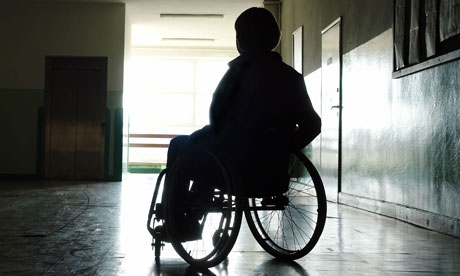 Demonisation of the disabled affects people whose lives are already difficult. Photograph: Alamy
Education is the ‘magic key’ for disability right
Education is the ‘magic key’ for disability rights

But there is a positive side as well. When disabled people are able to access their fundamental right to education, the benefits for society can be enormous. Just take the example of Anne Wafula Strike, a British-Kenyan Paralympian athlete who was the first East African to ever compete in a wheelchair sprint at the Paralympics in Athens in 2004. Anne grew up doubly disadvantaged, as a disabled girl in rural Kenya, but she has gone on to achieve more than most of us can imagine as a mother, teacher, author and athlete. Anne puts her success down to the fact that her supportive father pushed her to stick with education, even when things were so difficult – even the toilets at Anne’s school were inaccessible for her – that she wanted to quit.

Anne speaks at the parliamentary meeting on Tuesday, photo by Mark Chilvers
On Tuesday this week RESULTS worked with the All-Party Parliamentary Groups on Global Education for All and on Disability, and a group of other charities who work on inclusive education including ADD International and Sightsavers, to bring Anne in front of a group of MPs and Lords in the House of Commons. The meeting was chaired by Rt Hon David Blunkett MP, Vice-Chair of the APPG on Global Education for All and attendees included Chris Holmes, the Director of the 2012 Paralympic Games. Anne’s inspirational story helped to inform and educate the parliamentarians and other attendees about how the UK Government could help to ensure that all disabled children are able to access education.
In fact, the UK along with the rest of the international community is already committed to this goal, as it is enshrined in the Millennium Development Goals: MDG 2 commits us to ensure that all children are able to complete a primary education by 2015 – all children, not all except those living with disability. But far too little is still being done to meet this aim.

Anne with Chris Holmes, Director of the 2012 Paralympics, at Tuesday's event, photo by Mark Chilvers
There are good initiatives out there: for example the UK Department for International Development in Uganda is currently supporting the Ugandan Government to carry out a detailed mapping of special needs education provision, but we’re a very long way from systematically addressing this issue on the scale that is needed to reach the millions of excluded disabled kids. Many of the MPs who were present on Tuesday have committed to raise this issue with the Government and ask for more action to be taken, and we are hopeful that we are starting to see some changes.
As Anne said on Tuesday, ‘education was the magic key that opened doors for me…When I was growing up and even still today, I did not want sympathy, I wanted opportunity. I wanted to be given the opportunity to prove what I can do for the community, and I know this is what many other disabled people want as well.’ Today, please join the effort to make this happen. For more information about how you can help, contact the RESULTS office.
Subscribe to:
Posts (Atom)